
The High-Speed Challenges of Desert Night Driving
Desert running is one of the most exhilarating off-road activities, offering wide-open spaces, sweeping sand dunes, and challenging terrain. Whether you are skimming over whoop-sections or blasting down dry wash beds, the landscape moves fast. At night, this environment becomes exponentially more challenging. Standard factory headlights simply cannot keep up with the speeds of desert driving. To stay safe and maintain your pace after the sun goes down, upgrading your forward lighting with a high-performance LED light bar is a critical safety requirement. Choosing the right setup requires understanding the unique physics of desert terrain, dust, and vehicle speed.
Why Desert Running Demands Specialized Lighting
When you are cruising down a highway at highway speeds, your reaction times are aided by predictable pavement and clear lane markings. Off-road in the desert, those luxuries disappear. At high speeds, you can easily outrun your headlights. Outrunning your lights means your vehicle's stopping distance at a given speed is longer than the distance illuminated by your headlights. If a sudden washout, a massive boulder, or a steep drop-off appears in your path, you need to see it hundreds of feet in advance to react safely. Furthermore, desert terrain is notorious for silt beds and fine sand dust. When you are driving in a group or even running solo, your tires kick up a massive cloud of fine dust that hangs in the air. Standard white lights can reflect off this dust, creating a blinding wall of white glare that completely ruins your night vision. This is why specialized off-road lighting setups are required to cut through the elements and provide the necessary long-distance visibility.
Choosing the Right Beam Pattern for High-Speed Sand
When selecting an LED light bar, the optical design—specifically the beam pattern—is the most important factor. Off-road lights generally come in three primary beam patterns: spot, flood, and combo. Each serves a distinct purpose, but their effectiveness changes dramatically in the desert.
Spot Beams: The High-Speed Essential
Spot beams feature tight, highly focused optics that project a narrow beam of light over immense distances. For desert running, spot beams are your primary tool. By throwing light far down the trail, they give you the critical seconds needed to spot obstacles at high speeds. However, because the beam is so narrow, it offers very little peripheral illumination, which is why it must be paired with other patterns.
Flood Beams: Great for Crawling, Bad for Speed
Flood beams project a wide, short-range pattern of light. While excellent for low-speed technical rock crawling or campsite setup, they are highly inefficient for high-speed desert running. If you rely solely on flood beams at high speeds, you will illuminate the ground directly in front of your bumper perfectly, but you will remain completely blind to what lies 200 feet ahead. Additionally, too much foreground light causes your eyes to adjust to the brightness, actually reducing your distance vision.
Combo Beams: The Ultimate Versatility
A combo beam pattern combines both spot and flood optics within a single light bar housing. This is often the ideal choice for most desert drivers. The spot optics in the center throw light far down the track, while the flood optics on the outer edges illuminate the sides of the trail, helping you spot wildlife, branching trails, or debris in your periphery.
The Power of Amber: Fighting the Desert Silt with a 50-Inch LED Light Bar
One of the biggest hurdles in desert off-roading is silt. Silt consists of extremely fine dust particles that can hang in the air for minutes after a vehicle passes. When you shine a traditional bright white LED light into a silt cloud, the short-wavelength blue and white light bounces directly off the dust particles and reflects back into your eyes. This phenomenon, known as backscatter, makes it virtually impossible to see the trail ahead.

To combat this, experienced desert racers and overlanders rely on amber lighting. Amber light has a longer wavelength than white light, allowing it to penetrate through dust, fog, and airborne silt rather than reflecting off it. This drastically reduces glare and enhances contrast, allowing you to see the contours of the terrain even in dusty conditions. For the ultimate versatility, a dual-color system is the perfect solution. Investing in a high-quality 50-inch dual-color LED light bar with white and amber beams allows you to run high-intensity white light when the air is clear, and instantly switch to amber when you hit a dust storm or follow a lead vehicle. This dual-functionality ensures you are prepared for whatever conditions the desert throws at you.
Where to Mount Your LED Light Bar for Desert Driving
Where you mount your LED light bar is just as important as the light itself. Different mounting positions offer distinct advantages and disadvantages when navigating the desert. The most common mounting locations include the front bumper, bull bar, grille, hood line, roof rack, or above the windshield.

Roof Rack and Above the Windshield
Mounting a large light bar high on your roof rack or above the windshield maximizes both distance and spread. The high angle allows the light to throw over crests and illuminate a massive area. However, roof-mounted lights are prone to causing severe glare on your hood, which can be highly distracting. They also illuminate the dust directly in front of your windshield, which can worsen visibility in dusty conditions.
Front Bumper, Grille, and Bull Bar
For desert running, mounting a light bar low on the front bumper, bull bar, or grille is highly advantageous. Low-mounted lights cast longer shadows over terrain transitions, making it much easier to judge the depth of whoops, washouts, and ruts. More importantly, keeping the light source low minimizes backscatter because the light shines underneath your direct line of sight and underneath the worst of the dust cloud. It also completely eliminates hood glare.
Hood Line Mounts
A hood line mount is a fantastic middle ground. It positions the light bar high enough to get a decent throw while keeping it low enough to avoid the excessive hood glare and windshield dust reflection associated with roof mounts.
A Critical Note on Placement
While light bars are incredibly versatile, they must be mounted in the correct locations. Light bars should only be mounted on the front bumper, bull bar, grille, hood line, roof rack, or above the windshield. They should never be mounted on the A-pillar or used as ditch lights. A-pillars are reserved exclusively for compact pod or cube lights. Because of their size and design, mounting a wide light bar on the A-pillar would block your vision and cause dangerous glare, whereas compact pods can be easily angled outward to illuminate the sides of the trail safely.
Key Technical Specs: Honest Performance vs. Hype
The off-road lighting market is filled with exaggerated claims and cheap build quality. To ensure your light bar survives the brutal vibrations and extreme temperatures of the desert, you must look past the marketing hype and focus on real, honest technical specifications.
- Real Measured Lumens: Many budget brands advertise inflated raw lumen ratings that their lights can never actually achieve. High-quality off-road light bars provide honest, real-world measured outputs ranging from 4,800 lumens for compact bars up to 22,500 lumens for large roof-mounted bars. This honest output ensures you get maximum usable light without overloading your vehicle's electrical system.
- Power and Voltage: Desert light bars need to be highly efficient. Look for systems that draw between 30W to 390W depending on the length of the bar. A wide operating voltage of 9-36V ensures compatibility with a variety of off-road rigs and guarantees stable light output even during voltage fluctuations.
- Durability and Waterproofing: Desert driving is violent. Washboard roads, high-speed vibrations, and extreme heat will quickly destroy cheap lights. Look for a light bar housed in a rugged aluminum housing that acts as a heat sink to keep the LEDs cool. Most importantly, ensure the light bar has an IP68 waterproof and dustproof rating. This guarantees that fine desert silt and water from occasional wash crossings cannot penetrate the housing and ruin the electronics.
Comparing Single-Row vs. Dual-Row Light Bars
When choosing an LED light bar, you will have to decide between a single-row and a dual-row configuration. Both styles have their place in a desert rig, but they offer different benefits:

Single-Row LED Light Bars
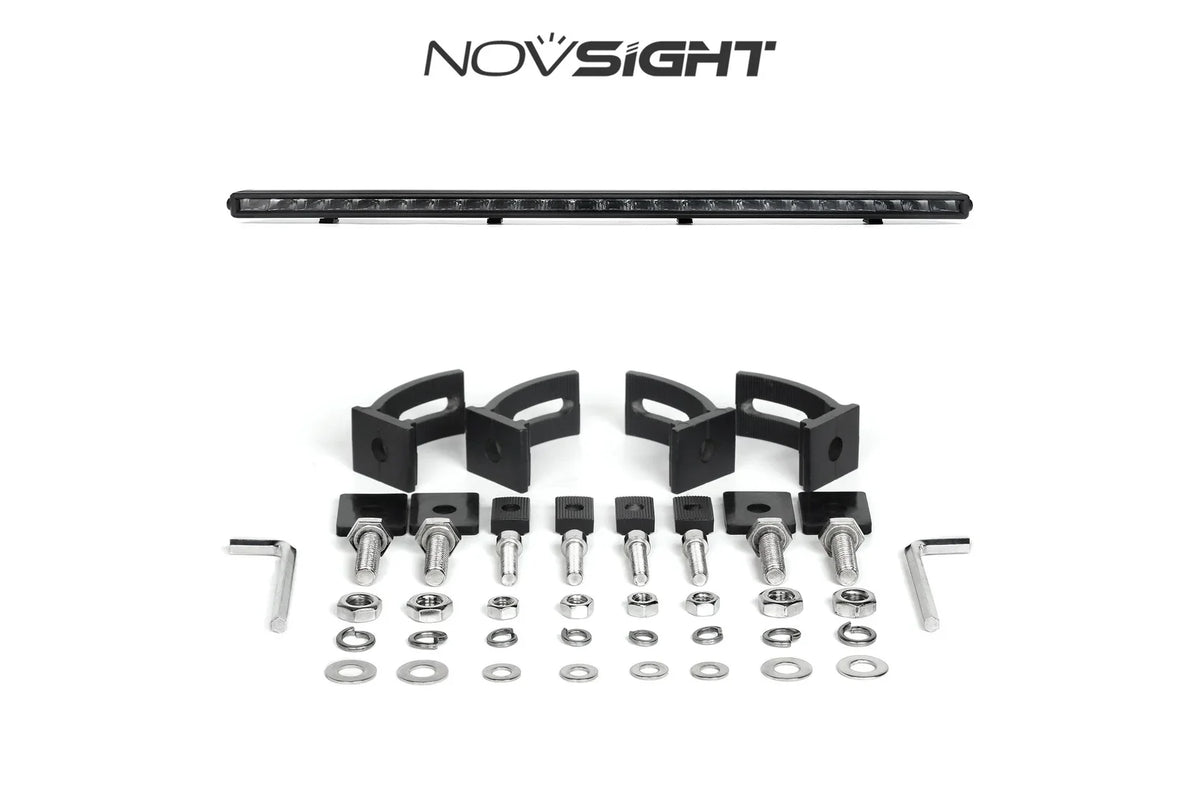
Single-row light bars feature a sleek, low-profile design with a single line of high-intensity LEDs. They are highly aerodynamic, making them the preferred choice for roof mounts where wind noise and drag can be an issue. Their compact size also makes them incredibly easy to tuck into tight spaces, such as behind grilles or flush-mounted inside aftermarket bumpers. They offer a highly focused, precise beam pattern that is excellent for long-distance spot lighting. Available in sizes like 8, 20, 30, 38, 48, and 52 inches, they offer great mounting versatility.
Dual-Row LED Light Bars
Dual-row light bars utilize two rows of LEDs stacked vertically. This design provides a larger housing and allows for double the LED chips, resulting in a fuller, wider beam pattern with maximum raw light output. If you are mounting a light bar on a massive front bumper or bull bar where space is not an issue, a dual-row light bar delivers unmatched illumination to light up the entire desert landscape. These also come with mounting brackets and are built for heavy-duty setups.
Frequently Asked Questions
Why is amber light better than white light for desert dust?
White light has a short wavelength that easily scatters when it hits airborne dust, silt, or fog, creating a blinding glare. Amber light has a longer wavelength that penetrates through these particles instead of reflecting off them, vastly improving visibility and reducing eye strain in dusty conditions.
Can I mount an 8-inch light bar on my A-pillar?
No. Light bars of any size, including small 8-inch or 20-inch models, should never be mounted on the A-pillar. A-pillars are designed exclusively for compact pod or cube lights. Mounting a light bar on the A-pillar can obstruct your field of view, cause extreme glare on your side mirrors, and look out of place. Keep light bars on your bumper, grille, hood line, or roof rack.
What is the ideal light bar size for a front bumper mount?
The ideal size depends on your bumper design, but 20-inch and 30-inch light bars are the most popular choices for front bumper and grille mounts. They provide an excellent balance of high light output and easy integration into most off-road vehicles without blocking airflow to your radiator.

Dejar un comentario
Todos los comentarios se revisan antes de su publicación.
Este sitio está protegido por hCaptcha y se aplican la Política de privacidad de hCaptcha y los Términos del servicio.