
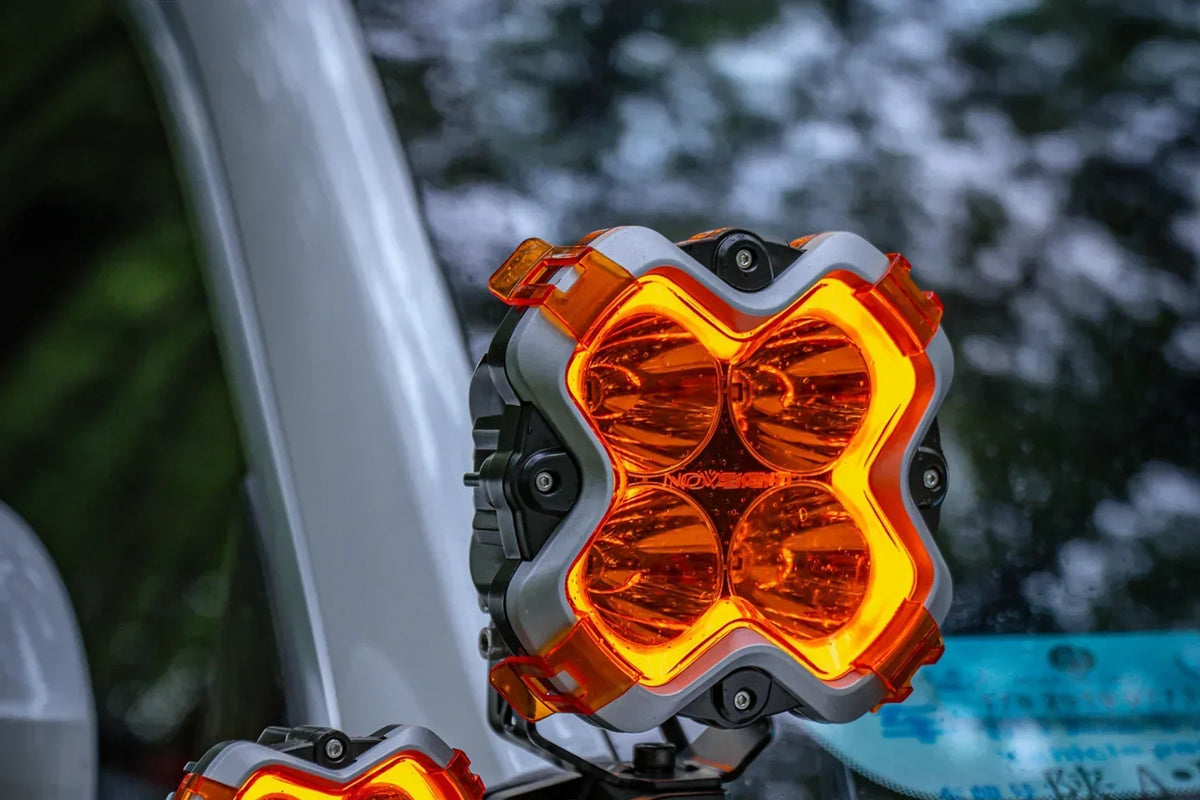
The Ultimate Off-Road Dilemma: White Light vs. Amber Light
Imagine this: You are pushing your rig through a fast-paced desert running session at dusk. The vehicle ahead of you kicks up a massive, hanging cloud of fine silt. You flick on your high-powered roof rack light bar, expecting to pierce the gloom, but instead, you are met with a blinding wall of white glare. It is like driving into a solid white sheet. Your eyes strain, your speed drops, and the trail ahead completely vanishes.
Every off-roader, overlander, and trail enthusiast eventually faces this challenge. Standard white light is fantastic for clear nights, but when the elements turn against you—whether it is hanging dust in the desert, thick morning mountain fog, or heavy winter snow—white light often does more harm than good. This is where the debate between white and amber LED pod lights begins. To build the ultimate lighting setup, you need to understand how light interacts with airborne particles and why selective yellow / amber is the go-to choice for challenging conditions.
The Physics of Light: Why White Light Fails in Dust and Fog
To understand why amber light outperforms white light in low-visibility environments, we have to look at the physics of light scattering. White light is actually a combination of all colors in the visible spectrum, including high concentrations of blue and cool-toned wavelengths. These shorter blue wavelengths are highly susceptible to a phenomenon known as backscatter.

When a beam of cool white light hits tiny airborne obstacles—such as dust particles, water droplets in fog, or falling snowflakes—the short wavelengths bounce off the particles and scatter in every direction. A large portion of this scattered light is reflected directly back into the driver’s eyes. This creates a blinding glare that dilates your pupils, making it incredibly difficult to see past the immediate front of your vehicle.
The Power of Selective Yellow / Amber
Selective yellow / amber light works by filtering out the troublesome blue and violet wavelengths from the light spectrum. Because amber light consists of longer wavelengths, it does not scatter as easily when it collides with small airborne particles. Instead of bouncing directly back into your eyes, the longer wavelengths pass more cleanly through the dust and moisture, illuminating the terrain ahead rather than the air directly in front of your windshield.
Furthermore, the human eye is naturally more sensitive to the yellow-green spectrum. In high-stress driving conditions like high-speed desert running, amber light reduces eye fatigue and allows your brain to process contrast and depth perception much more quickly. You can spot washouts, ruts, and rocks in the dust trail before they become immediate hazards.
Real-World Scenarios: Desert Running and Trail Crawling
Different off-road disciplines require different lighting strategies. Choosing the right light color and placement depends heavily on the environments you frequent.

1. Desert Running
In high-speed desert environments, dust is your primary adversary. Silt clouds can hang in the air for minutes, especially in valleys with zero wind. If you are running in a group, the dust kicked up by lead vehicles creates an impenetrable barrier. For this scenario, low-to-mid-mounted amber lights are essential. They allow you to maintain a safe tracking distance and spot obstacles early enough to react at speed.
2. Mountain Fog and Forest Trails
Fog behaves similarly to dust but consists of suspended water droplets. Because water droplets are highly reflective, white lights will create a literal wall of fog. Mounting amber lights low on your bumper helps project light underneath the main fog bank, while the selective yellow / amber spectrum prevents the blinding backscatter from reaching your windshield.
Configuring Your Rig with LED Pod Lights
When building your lighting layout, versatility is key. Relying on a single light bar or one set of lights limits your capability. High-quality LED Pod Lights offer the perfect modular solution, allowing you to mix and match colors, beam patterns, and mounting locations to tackle any environment.

For the ultimate setup, consider these crucial mounting locations:
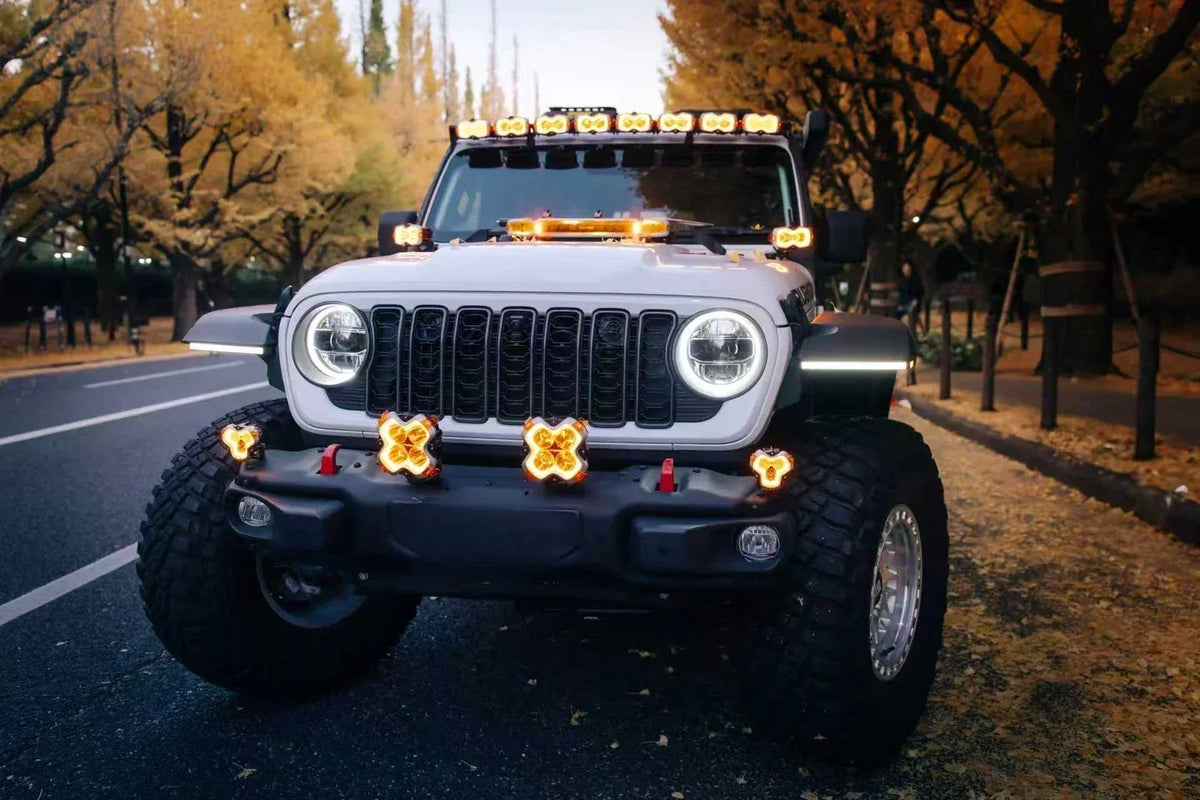
- A-Pillar / Ditch-Light Mounting: Pods mounted at the base of your windshield are excellent for illuminating the sides of the trail. When using amber pods here, they help define the trail edges in dusty conditions without reflecting off your hood.
- Bumper Pods: Mounting pods directly on or inside your front bumper places the light source closer to the ground, which is ideal for cutting under fog and heavy dust clouds.
- Fog-Light Locations: Replacing factory fog lights with amber LED pods gives you a highly functional, everyday foul-weather light source.
When selecting your gear, look for robust systems built to withstand the elements. Novsight offers versatile LED Pod Lights in 3, 4, and 6-inch cubes/pods that are perfect for these exact mounting locations. With power ratings ranging from 40W to 184W and light outputs spanning roughly 3,200 to 13,000 lumens, you can find the exact intensity your build demands. These pods are engineered with a wide 10-30V voltage range, feature spot, flood, or combo beam options to customize your light spread, and include a complete wiring harness for a clean, hassle-free installation. Plus, with an IP68 waterproof rating, they are built to survive torrential downpours, deep silt beds, and muddy trail runs.
Amber vs. White: Comparison at a Glance
To help you decide how to split your lighting budget, here is a quick comparison of how amber and white pod lights perform across different categories:
- Clear Night Trails: White light wins. It offers maximum distance, high brightness, and natural color rendering when the air is completely clear.
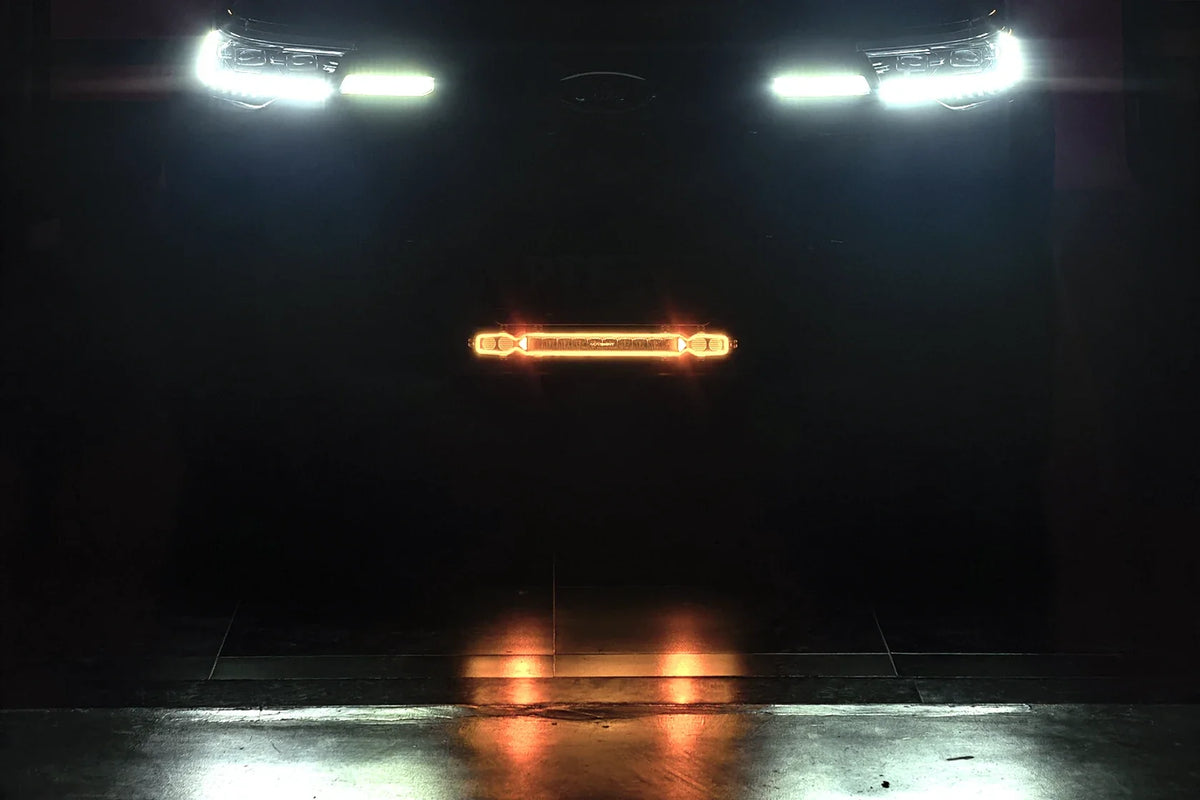
- Heavy Dust & Silt: Amber light wins decisively. It minimizes backscatter, reduces glare, and allows you to maintain speed during desert running.
- Thick Fog & Snow: Amber light wins. It cuts through moisture droplets far better than cool white light, reducing eye strain.
- Peripheral Trail Detail: A combination of both is ideal. White flood lights illuminate side-trail foliage on clear nights, while amber ditch lights maintain peripheral vision when the trail gets dusty.
The Hybrid Approach: The Best of Both Worlds
You do not have to choose just one. In fact, most experienced overlanders and off-road racers utilize a hybrid lighting system. By running white lights for primary high-speed distance illumination on clear nights, and dedicating your bumper and ditch-light zones to selective yellow / amber LED pods, you prepare your vehicle for any weather or trail condition imaginable. This dual-zone approach ensures that when the clear night sky suddenly turns into a blinding dust storm or a dense fog bank, you are only a switch-flip away from perfect visibility.
Frequently Asked Questions
Is selective yellow the same as amber?
While they are very similar and often used interchangeably in the off-road community, selective yellow is slightly lighter and closer to the yellow spectrum, whereas amber has a deeper orange hue. Both serve the same primary purpose: filtering out blue light wavelengths to reduce glare and backscatter in dust, fog, and snow.
Can I use amber LED pod lights on public highways?
This depends heavily on your local and state laws. Generally, amber lights mounted low on the bumper and operated as fog lights are legal for street use in inclement weather, provided they comply with local SAE/DOT regulations. However, high-output off-road pods mounted on the A-pillars or roof should always be covered or switched off when driving on public, paved roads.
Why should I choose pod lights over a large light bar for dust?
Pod lights offer much greater mounting flexibility and precise aiming. Large light bars mounted on the roof rack are positioned high up, which actually maximizes backscatter directly into the driver’s line of sight during dusty or foggy conditions. Smaller 3, 4, or 6-inch pod lights can be mounted lower on the bumper or A-pillars, allowing you to direct the light exactly where you need it while keeping the glare below your field of vision.

Hinterlasse einen Kommentar
Alle Kommentare werden vor der Veröffentlichung geprüft.
Diese Website ist durch hCaptcha geschützt und es gelten die allgemeinen Geschäftsbedingungen und Datenschutzbestimmungen von hCaptcha.